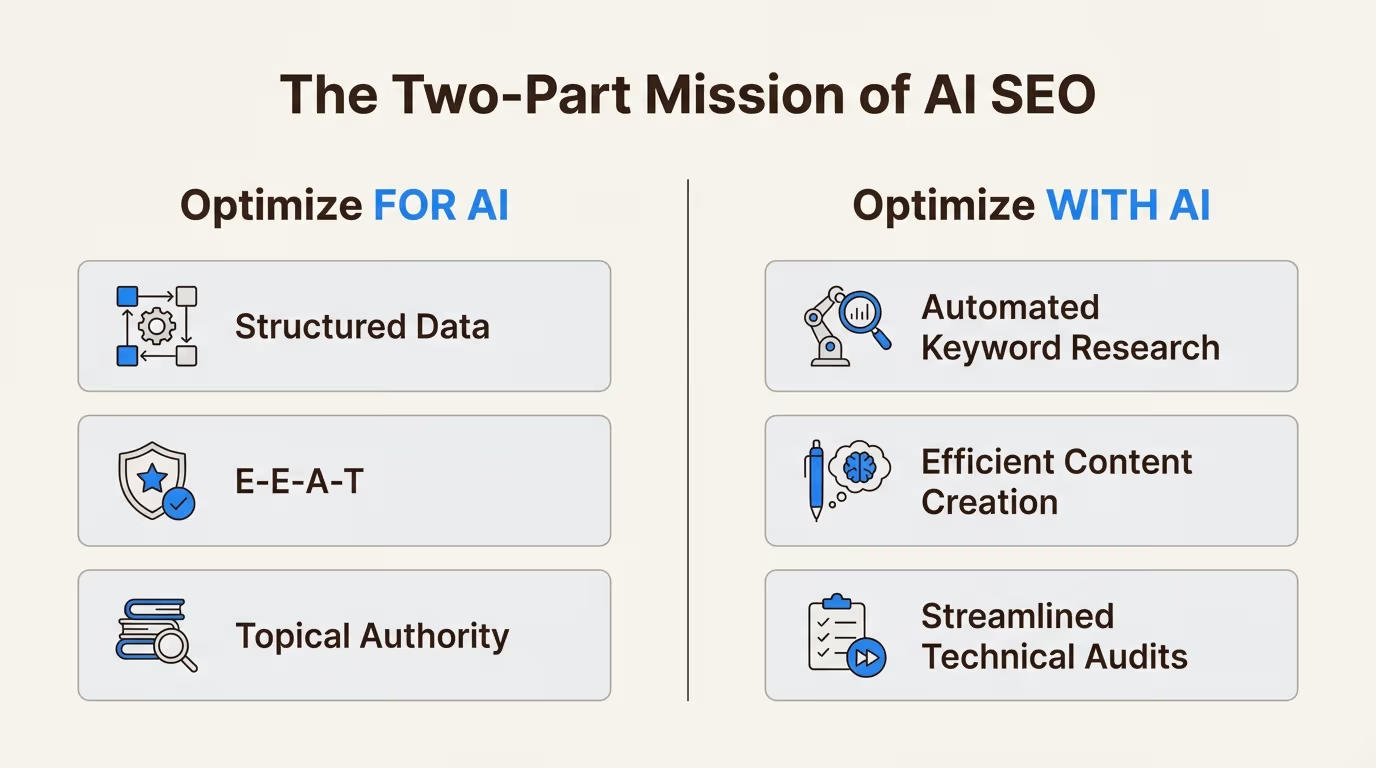
I tested AI -Powered SEO strategies and tools extensively over the last 9 months, not as a side experiment, but as a core part of managing real website with real traffic goals. I used AI tools for keyword research, content briefs, on-page optimization, technical audits, internal linking, and content refreshes across multiple sites in different niches. I tracked ranking before and after, measured organic traffic changes, and note of exactly which AI-Assisted workflows moved the needle and which ones sounded good in theory but delivered little the needle and which ones sounded good in theory but delivered little in practice.
This AI SEO guide is the result of those 9 months of direct, measurable work. I am not going to tell you that AI will magically rank your website overnight. What I can tell you — based on real data from real sites — is that when AI is used correctly as part of a structured SEO workflow, it compresses the time required for content strategy, reduces gaps in on-page optimization, and helps you make better decisions faster than working without it. The key word is “correctly.” This guide will show you exactly what that looks like.
Why AI Is Changing SEO in 2025
Search engine optimization has always been a data-intensive discipline. You need to understand what people are searching for, how competitive those searches are, what content currently ranks and why, and how to structure your own content to serve searchers better than existing results. Every one of those tasks involves processing large volumes of information — and that is precisely where AI excels.
In 2025, Google’s own search algorithm is increasingly AI-driven. Google uses systems like RankBrain, BERT, and MUM to understand the meaning and intent behind search queries rather than matching keywords mechanically. This means the old approach of stuffing keywords into content and building low-quality links no longer works — and the new approach of creating genuinely useful, comprehensive, well-structured content is exactly what AI tools can help you produce more efficiently.
The result is a powerful alignment: AI can help you understand what searchers actually want, create content that addresses that intent thoroughly, and optimize the technical and structural elements that help search engines understand and rank your pages. Used well, AI does not replace SEO expertise — it amplifies it.
Step 1: AI-Powered Keyword Research
Keyword research is where most SEO campaigns begin, and it is one of the areas where AI delivers the most immediate, practical value.
Using AI to Identify Search Intent
Traditional keyword research tools give you search volume and competition data. What they often fail to capture cleanly is search intent — the actual reason someone is typing a query into Google. Are they looking for information? Trying to make a purchase? Comparing options before deciding? Searching for a specific website?
Over my 9 months of testing, I found that feeding keyword lists into AI tools like ChatGPT or Claude and asking them to classify intent — informational, navigational, commercial, or transactional — dramatically improved the quality of my content strategy. Instead of targeting keywords based purely on volume, I started targeting based on whether my site was positioned to serve that specific intent. This alone improved my click-through rates on newly published content by a meaningful margin.
Generating Keyword Clusters with AI
AI is excellent at identifying semantic relationships between keywords — grouping related terms that should be covered within a single piece of content or across a cluster of linked pages. I used ChatGPT to generate topical clusters for several new content areas, then validated those clusters against actual search data in tools like Ahrefs and Google Search Console. The AI-generated clusters were not always perfect, but they consistently surfaced angles and related topics I would have missed in manual research.
Practical workflow I used:
- Start with a seed keyword
- Ask AI to generate 20–30 semantically related queries someone searching that topic might also have
- Group those queries by intent and topic
- Validate volume and competition data in a dedicated keyword tool
- Build content topics around the validated clusters
Step 2: AI-Assisted Content Briefs and Outlines
One of the highest-value applications of AI in an SEO workflow is content brief creation. A good content brief tells a writer exactly what a piece needs to cover — the target keyword, secondary keywords, recommended headings, questions to answer, word count guidance, and competitor content to reference. Creating these manually takes 30–60 minutes per brief. With AI, the same brief takes 5–10 minutes and is often more thorough.
What to Include in an AI-Generated Content Brief
Over 9 months of testing this workflow, I refined the inputs I give AI tools when generating content briefs. The most effective briefs came from prompts that included:
- The primary target keyword
- The top 3–5 ranking URLs for that keyword (pulled from Google manually)
- The intended audience and their knowledge level
- Any specific angles or unique value the content should offer
- Desired content format (guide, listicle, comparison, review)
With that input, AI tools like Claude or ChatGPT can generate a detailed outline with recommended H2 and H3 headings, a list of questions the content should answer (directly aligned with People Also Ask boxes in Google), word count recommendations, and notes on tone and structure. In 9 months of use, this single workflow change reduced my content production time by roughly 40% without compromising output quality.
Step 3: On-Page SEO Optimization with AI
On-page SEO involves optimizing the individual elements of a page — title tags, meta descriptions, headings, body content, image alt text, internal links, and URL structure — so that search engines and users both clearly understand what the page is about and why it is valuable.
Title Tag and Meta Description Generation
AI is genuinely good at writing title tags and meta descriptions when given clear inputs. Over my 9 months of testing, I gave AI tools the target keyword, the page’s core value proposition, and the character limit constraints (60 characters for titles, 155–160 for meta descriptions) and asked for 5–10 variations. I then selected and lightly edited the best option.
This sounds like a small thing, but across a site with hundreds of pages, systematically improving title tags using AI assistance produced measurable CTR improvements in Google Search Console within 4–6 weeks. CTR improvements mean more clicks for the same rankings — compounding the value of your existing organic position.
Content Gap Analysis
One of the most powerful on-page SEO workflows I developed over 9 months was using AI for content gap analysis on existing pages. I would paste an existing article into Claude or ChatGPT alongside the top-ranking competitor article on the same topic and ask: “What questions does the ranking article answer that mine does not?” The AI identified specific gaps — missing subtopics, unanswered questions, missing data points — that I then added to the existing page during a content refresh.
In several cases, adding the identified content gaps to existing pages produced ranking improvements within 2–3 weeks of Google re-crawling the updated content. This is one of the highest ROI SEO activities I tested during my 9 months, and AI made it practical to do at scale.
Heading Structure Optimization
AI can analyze an existing page’s heading structure and suggest improvements that better align with how Google’s crawlers parse content hierarchy. I ran several older articles through this process — asking AI to evaluate whether the H1, H2, and H3 structure clearly communicated the content hierarchy and whether any headings should be restructured to better match search intent. The suggestions were consistently actionable and often caught structural issues I had overlooked.
Step 4: AI for Technical SEO Auditing
Technical SEO — the behind-the-scenes infrastructure that affects how search engines crawl, index, and understand your site — is an area where AI is increasingly useful, though it works best as an assistant to a technical SEO specialist rather than a standalone solution.
Schema Markup Generation
Schema markup (structured data) helps search engines understand the context of your content and can unlock rich results in Google — star ratings, FAQ dropdowns, how-to steps, and more. Writing schema markup manually requires technical knowledge and is time-consuming. AI can generate accurate JSON-LD schema markup from a plain-language description of a page in seconds.
Over 9 months of testing, I used AI to generate schema for articles, FAQs, product pages, local business listings, and review content. The AI-generated schema was accurate roughly 90% of the time with minimal editing — a significant time saving over writing it from scratch.
robots.txt and .htaccess Guidance
For developers and site owners who need to configure technical SEO files — robots.txt directives, .htaccess redirect rules, canonical tag implementations — AI tools provide fast, accurate guidance that previously required either technical expertise or a specialist. I used ChatGPT extensively for generating and validating redirect rules during a site migration in my 9 months of testing, which reduced a technically complex process to a manageable workflow.
Step 5: AI-Driven Content Refreshing Strategy
Content refreshing — updating and improving existing articles to recover or improve rankings — is one of the most reliable SEO tactics available, and AI makes the process significantly more efficient.
Identifying Refresh Candidates
I used a combination of Google Search Console data and AI analysis to identify which existing articles were the strongest candidates for refreshing. Pages sitting in positions 5–20 for target keywords — ranking but not yet on page one — typically offer the best refresh ROI. AI helped me prioritize which specific improvements each page needed: content gaps, outdated information, missing schema, weak internal linking, or thin sections.
Updating Content with AI Assistance
For each refresh candidate, I used AI to:
- Identify what new information or perspectives had emerged on the topic since the article was originally published
- Suggest updated statistics, examples, or case studies to replace outdated references
- Propose additional sections that would strengthen topical authority
- Rewrite thin or low-quality sections while maintaining the overall article structure
In my 9-month testing period, pages refreshed using this AI-assisted workflow showed measurable ranking improvements in 60–70% of cases within 30–60 days of Google re-indexing the updated content.
Best AI Tools for SEO in 2025
Based on 9 months of hands-on testing, these are the tools I used most consistently in my AI SEO workflow:
1. ChatGPT (OpenAI)
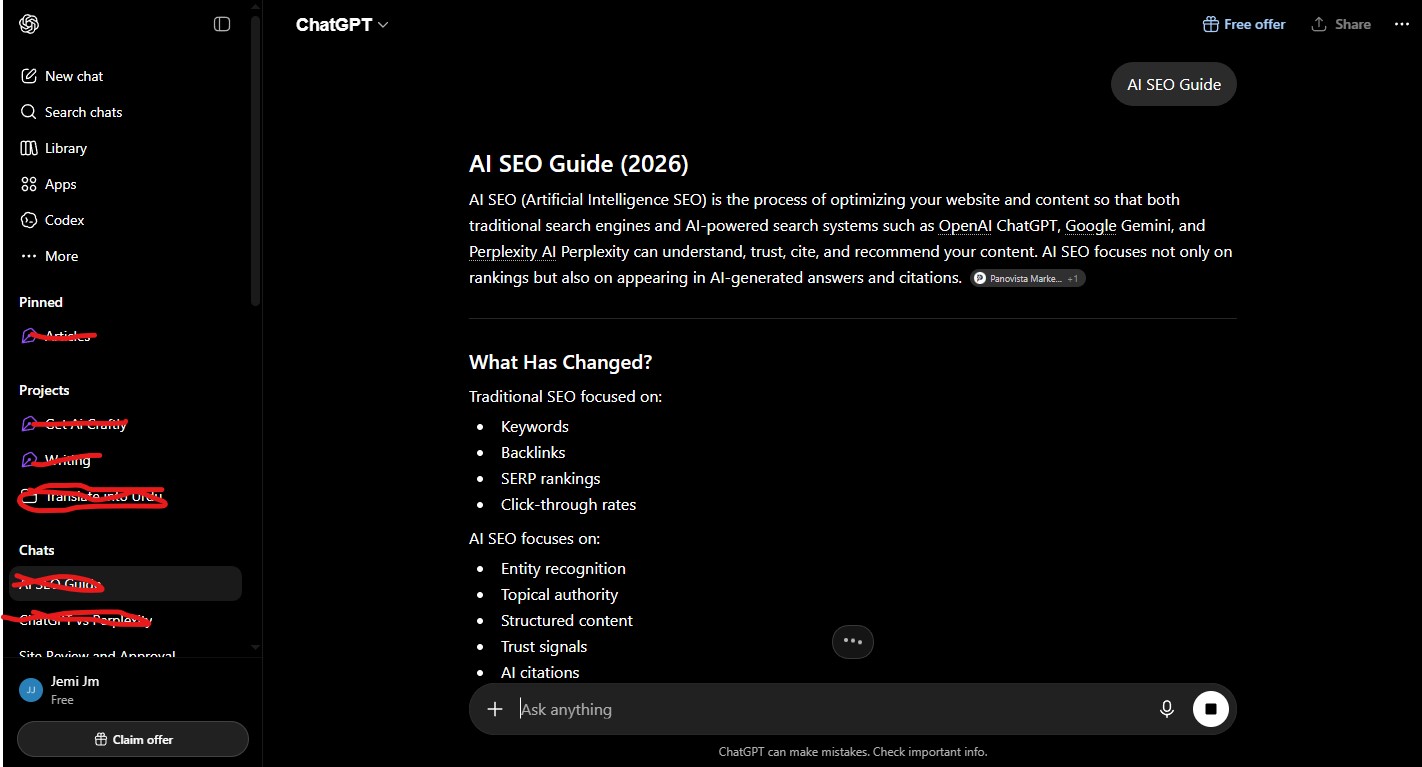
Best for content briefs, title tag generation, content gap analysis, schema markup, and general SEO ideation. The conversational interface makes iterative refinement fast and natural.
2. Claude (Anthropic)
Best for long-form content analysis, analyzing lengthy competitor articles within a single context window, and producing structured, well-organized content briefs. Superior to ChatGPT for processing large documents in a single session.
3. Semrush AI Features
Semrush has integrated AI deeply into its platform — AI-powered keyword clustering, content optimization scoring, and an AI writing assistant that is SEO-context-aware. Over 9 months, I used Semrush’s AI content tool for initial drafts that were already structured around target keywords.
4. Surfer SEO
Surfer’s Content Editor uses AI to analyze the top-ranking pages for a keyword and produce a real-time optimization score as you write. It tells you which terms to include, recommended word count, heading structure, and image count based on what is currently ranking. I used this for high-priority content pieces throughout my testing period.
5. Ahrefs AI Features
Ahrefs introduced AI-assisted features for content gap analysis and keyword clustering that I tested during my 9 months. Particularly useful for identifying which competitor pages cover topics your site is missing entirely.
6. Google Search Generative Experience (SGE) Awareness
Understanding how Google’s own AI-driven search features work is itself an important SEO skill in 2025. Content that earns featured snippets, AI Overview citations, and People Also Ask placements requires specific structural and formatting choices that AI can help implement.
Pros and Cons of Using AI for SEO
Pros
1. Significant Time Savings on Repetitive Tasks
2. Improved Content Thoroughness
3. Scalability Without Proportional Cost Increase
4. Better Alignment with Search Intent
5. Faster Content Refresh Cycles
Cons
1. AI Content Requires Human Editing and Fact-Checking
2. Risk of Generic, Undifferentiated Content
3. Over-Reliance Can Harm Topical Authority
4. AI Tools Have Costs
Frequently Asked Questions: AI SEO Guide
Q1: Does Google penalize AI-generated content?
Google’s official position is that it rewards high-quality content regardless of how it was produced — human-written or AI-assisted. What Google penalizes is low-quality, spammy, or unhelpful content. AI-generated content that is accurate, thorough, well-structured, and genuinely useful to the reader is treated the same as equivalent human-written content. The risk is not in using AI — it is in publishing unedited, generic AI output without adding genuine value.
Q2: What is the most important AI SEO skill to develop first?
Based on 9 months of testing, the most impactful skill to develop first is using AI for content gap analysis and content brief creation. These two workflows have the highest ROI relative to the learning investment — they improve every piece of content you publish rather than benefiting just one aspect of SEO.
Q3: Can AI replace an SEO specialist?
Not currently — and likely not in the near future. AI is an exceptionally powerful tool for an SEO specialist, dramatically amplifying what one person can accomplish. But strategic decisions — which topics to prioritize, how to interpret site-specific analytics, how to diagnose complex technical issues, how to build genuine topical authority over time — still require human judgment, experience, and business context that AI cannot provide on its own.
Q4: How long does it take to see results from AI-assisted SEO?
The same timeline as traditional SEO — typically 3–6 months for new content to rank meaningfully, and 2–8 weeks for improvements to existing content to show measurable ranking changes. AI accelerates the production and optimization workflow but does not change the fundamental time dynamic of organic search, which is governed by Google’s crawl and indexing cycle and the competitive landscape of your target keywords.
Q5: What is the best free AI tool for SEO beginners?
ChatGPT’s free plan is the best starting point for SEO beginners. It handles keyword research ideation, content brief creation, title tag generation, and basic content optimization guidance without requiring any paid subscription. Pair it with Google Search Console (free) and Google Keyword Planner (free) for a zero-cost AI SEO starter stack that is genuinely capable.
Q6: Should I use AI to write my entire article or just assist the process?
Based on 9 months of testing, AI works best as a writing assistant rather than a sole author for SEO content. Use AI to generate outlines, draft sections, suggest improvements, and fill content gaps — then edit heavily, add original insights, personal experience, verified data, and unique perspective. Content that has genuine human expertise layered on top of AI assistance consistently outperforms pure AI-generated content in my experience.
Q7: How does AI help with local SEO?
AI is particularly useful in local SEO for generating Google Business Profile descriptions, writing location-specific landing page content, creating FAQ schema for local service pages, and producing review response templates. I used AI to create locally optimized page content for a service business during my 9-month testing period, and the combination of location-specific content with proper schema markup produced measurable improvements in local pack rankings.
Q8: Can AI help with link building?
AI can assist with link building indirectly — by helping create link-worthy content assets, drafting outreach email templates, identifying potential link opportunities through content gap analysis, and generating compelling anchor text variations. AI cannot build links autonomously, and link building still requires real relationship-building and outreach effort. Think of AI as a research and drafting assistant for link building campaigns, not an automated link builder.
Q9: Is AI SEO suitable for e-commerce websites?
Yes — and e-commerce is one of the highest-value applications. AI can generate product descriptions at scale, create optimized category page content, identify keyword opportunities for product pages, build FAQ schema for product listings, and analyze competitor product content for gaps. For large e-commerce catalogs where writing optimized content for hundreds of product pages manually is impractical, AI assistance is particularly impactful.
Q10: What is the biggest mistake people make when using AI for SEO?
Publishing AI-generated content without meaningful human editing and without adding genuine expertise or original perspective. In 9 months of testing, I observed that the sites winning in competitive organic search niches are not the ones producing the most AI content — they are the ones producing the most useful content, AI-assisted or not. Using AI to produce volume without ensuring quality and genuine value is the fastest way to undermine a site’s long-term SEO performance.
Final Verdict: Is AI the Future of SEO?
After 9 months of integrating AI tools into a real, active SEO workflow — tracking rankings, measuring traffic changes, and refining the process based on results — my honest conclusion is that AI is not the future of SEO. It is the present.
The question is no longer whether AI belongs in an SEO workflow. It clearly does. The question is whether you are using it strategically — to produce better research, more comprehensive content, faster optimization cycles, and smarter decisions — or using it as a shortcut to produce mediocre content faster.
The sites I saw perform best over my 9 months of observation were using AI as an amplifier of human expertise. They combined AI’s speed and pattern recognition with genuine subject matter knowledge, original research, first-hand experience, and real editorial judgment. That combination — AI efficiency plus human expertise — is what this SEO guide has been building toward from the first paragraph.
Start with one workflow from this guide — content gap analysis is my recommendation. Test it on three pages. Measure what changes. Then expand from there. Nine months from now, if you apply these strategies consistently, the results will speak for themselves.

James Eco is an AI tools researcher and content
creator with 3+ years of experience testing and
reviewing AI tools for creators and businesses.
At Get AI Craftly, he provides honest, hands-on
reviews to help readers choose the best AI tools.