
Cybersecurity is just one of several industries that artificial intelligence (AI) is quickly changing. AI has two effects on the industry: on the one hand, cybercriminals are using AI to carry out more complex and focused cyberattacks; on the other hand, AI is significantly advancing cybersecurity defenses, allowing security teams to detect and react to attacks more quickly and accurately than in the past.
We’ll examine this shift in cybersecurity in this blog post by examining how cybersecurity professionals are utilizing AI to counter increasingly complex and focused attacks.
Fighting the ongoing battle of digital vulnerabilities with AI in cybersecurity
Recent years have seen a sharp rise in cyber vulnerabilities, and this exponential growth is mostly due to the quick development of artificial intelligence. Hackers and cybercriminals may more successfully exploit weaknesses, evade detection, carry out more complex assaults, and expand their operations thanks to artificial intelligence.
The rise of AI cyberattacks: How hackers use AI to breach security
Figure 1 shows the key ways that AI can amplify cyberattacks, including:
- AI-powered phishing attacks
- Malware and ransomware powered by machine learning
- AI in social engineering
AI-powered phishing attacks
Phishing attacks are a kind of cyberattack where a cybercriminal poses as a reliable source in order to deceive a victim into divulging private information.
Phishing assaults have become more realistic and intimate thanks to AI-powered methods like deepfakes and sophisticated AI-driven impersonations, which also make them harder to identify. For instance, phone calls where the caller pretends to be someone else have been occurring for decades; however, AI allows the attacker to add the target’s personal information.
Cybercriminals employ a variety of AI learning models, such as voice cloning, behavioral analysis, and natural language processing (NLP) models, to produce hyperrealistic AI-generated cyber impressions in AI phishing assaults. Attackers can more easily fool their targets and boost their success rates by employing these technologies to successfully imitate the appearance, voice, or even writing and speaking styles of friends and coworkers.
Deepfakes are the latest tool in AI-driven phishing
Cybercriminals employ a variety of AI learning models, such as voice cloning, behavioral analysis, and natural language processing (NLP) models, to produce hyperrealistic AI-generated cyber impressions in AI phishing assaults.
Early in 2024, a Hong Kong employee joined a video conference with con artists who utilized deepfake images of his colleagues to persuade him to give them US$25 million in business funds.
Bot operators using AI to pivot more quickly after being detected
Bot management has always been a game of cat and mouse: security firms develop more accurate detections, bot operators figure out how to avoid those detections, security firms develop new detections, and so on.
AI enables bot operators to control behavior in increasingly complex ways to utilize more adaptive attack techniques, shorten the time required to avoid new detections, and more accurately mimic human-like engagement. The following are signs that a bot operator is using AI:
- Rapid evolution of tactics – Attack methods shift quickly in response to detection.
- Increased variation in behavior – AI-driven bots can use techniques like automated fuzzing to explore permutations to try and bypass defenses.
- Human-like interaction mimicry – This involves advanced imitation of real user behavior, including randomized patterns in clicks, keystrokes, or mouse movements.
Malware and ransomware powered by machine learning
Cyberthreats powered by AI can take many different shapes. The quick advancement of AI malware in recent years has made it possible for hackers to create more sneaky and flexible malware, greatly increasing the potency of ransomware and malware attacks.
With the use of AI, ransomware—a kind of virus that encrypts a victim’s data and demands a fee to unlock it—has grown more dangerous. Cybercriminals can now employ AI in ransomware operations to evade detection and carry out more sophisticated, quicker attacks.
Hackers can more successfully get around security safeguards thanks to AI-powered adaptive malware. This kind of machine learning malware can change its activities, communication style, and code to evade detection by conventional security measures by learning how to imitate genuine user behavior through network traffic analysis.
Additionally, machine learning algorithms allow attackers to target the most valuable data, more accurately discover security system flaws, and customize encryption techniques to the unique features of a system, making it more difficult to decrypt the stolen data. In order to speed up operations and give victims less time to react, some ransomware criminals now employ AI to automate specific processes like encryption.
AI in social engineering
In order to get sensitive information or assets from their targets, social engineering attackers use psychological manipulation and deceit. Attackers can construct more individualized frauds that are harder for people to spot by utilizing AI in social engineering.
Cybercriminals can create highly customized social engineering frauds because to AI analysis. Attackers can create communications that seem amazingly authentic and are more likely to be trusted by sprinkling personal information, recent events, and emotional triggers from the target’s digital footprint throughout phishing emails and other correspondence.
The role of AI in threat detection and security
AI has the capacity to strengthen cyberthreats, but it also has the potential to strengthen cybersecurity. Threat-hunting AI technology can assist enterprises in identifying and addressing risks more quickly and accurately than with conventional methods by utilizing machine learning.
A few use cases for AI in enhancing security systems include:
- Elevating threat detection with AI
- Prioritizing threats and automating responses
- Enhancing predictive threat intelligence
- Understanding the limitations of AI and when it may not be the answer
Elevating threat detection with AI
Machine learning algorithms enable AI-driven cybersecurity systems to evaluate enormous volumes of data in real time, spot patterns, and spot abnormalities that can point to possible risks. Cybersecurity experts may now identify security incidents more quickly and precisely than ever because to the speed of this analysis.
Security experts can also identify infamously hard-to-spot risks like lateral movement with the aid of advanced machine learning AI capabilities. Attackers employ lateral movement as a strategy to find high-value targets and increase their access while moving through a network covertly.
Prioritizing threats and automating responses
By enabling automated incident responses, which greatly reduce response times when compared to manual human intervention, AI also plays a crucial role in strengthening security operations. AI-automated incident response helps firms minimize possible harm before a problem can worsen by quickening the reaction to threats.
This is how it operates: AI-based solutions automatically carry out predetermined steps to mitigate the risk if a danger is identified, such as isolating a compromised asset or preventing hostile traffic from accessing a network. Furthermore, machine learning AI systems rank replies according to urgency and evaluate the seriousness of threats.
Enhancing predictive threat intelligence
Cybersecurity experts can improve the accuracy of their threat detection capabilities by using artificial intelligence to anticipate and stop possible threats based on past trends.
Large datasets from many sources are analyzed by machine learning AI algorithms. The cybersecurity teams can start to spot trends and patterns through this examination of data from prior incident reports, security logs, network traffic patterns, and more, improving their comprehension of typical cyberthreats.
Understanding limitations: When AI may not be the answer
Even while AI can significantly improve cybersecurity, it’s crucial to keep in mind its limitations.
AI systems don’t have the same capacity as humans to take into account the larger context; instead, they just learn from the data that is provided to them. As a result, AI systems may find it difficult to make decisions in complicated, nuanced circumstances. An AI system will make decisions that are biased or lack context if it was trained on incomplete or biased data.
Navigating the future of AI in cybersecurity
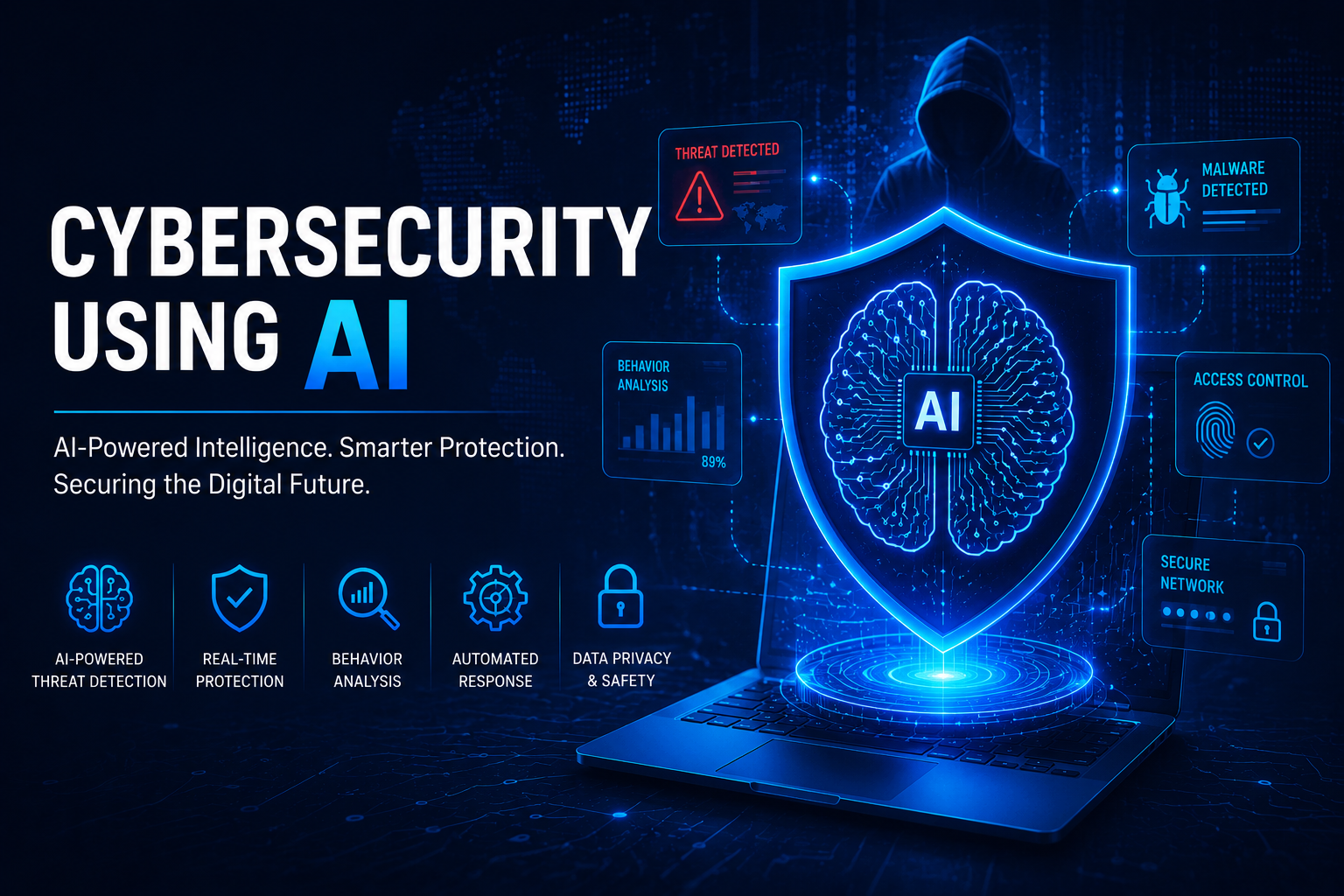
It is anticipated that the application of AI would only increase across industries. According to a recent McKinsey poll on the state of AI, 71% of participants said their companies regularly use generative AI in at least one business function. This is a huge increase from just 33% in 2023 and up from 65% last year.
In the upcoming years, AI systems are expected to play an even bigger part in cyber protection as they develop. Threat detection and mitigation will probably progress further thanks to AI, enabling cybersecurity teams to continuously scale their operations and respond to threats more quickly.
Embracing AI for a more secure digital world
AI is becoming more and more important in cybersecurity and cyberattacks. Akamai is at the forefront of purposefully and openly deploying AI to bolster security in response to an ever-expanding, highly sophisticated threat scenario.
AI-powered cybersecurity solutions from Akamai carry out a number of vital functions. Organizations are now able to identify and address threats more quickly and precisely than ever before thanks to cutting-edge AI-powered solutions like Akamai Hunt. The Akamai Guardicore Platform helps clients achieve Zero Trust, lower the risk of ransomware, and comply with regulations by combining state-of-the-art AI with Akamai knowledge.
Boost the security posture of your company with cybersecurity solutions that make responsible and efficient use of AI.

James Eco is an AI tools researcher and content
creator with 3+ years of experience testing and
reviewing AI tools for creators and businesses.
At Get AI Craftly, he provides honest, hands-on
reviews to help readers choose the best AI tools.