After using Claude AI, consider how Claude, as a conversational AI chatbot, mirrors the future of AI writing tools. I tried out Claude’s free plan, focused on writing, editing, brainstorming, coding explanations, and structured SEO activities. The goal was straightforward: to discover how technologies like Claude assist marketers and SEO professionals in real-world use cases, as well as where their limitations remain relevant.
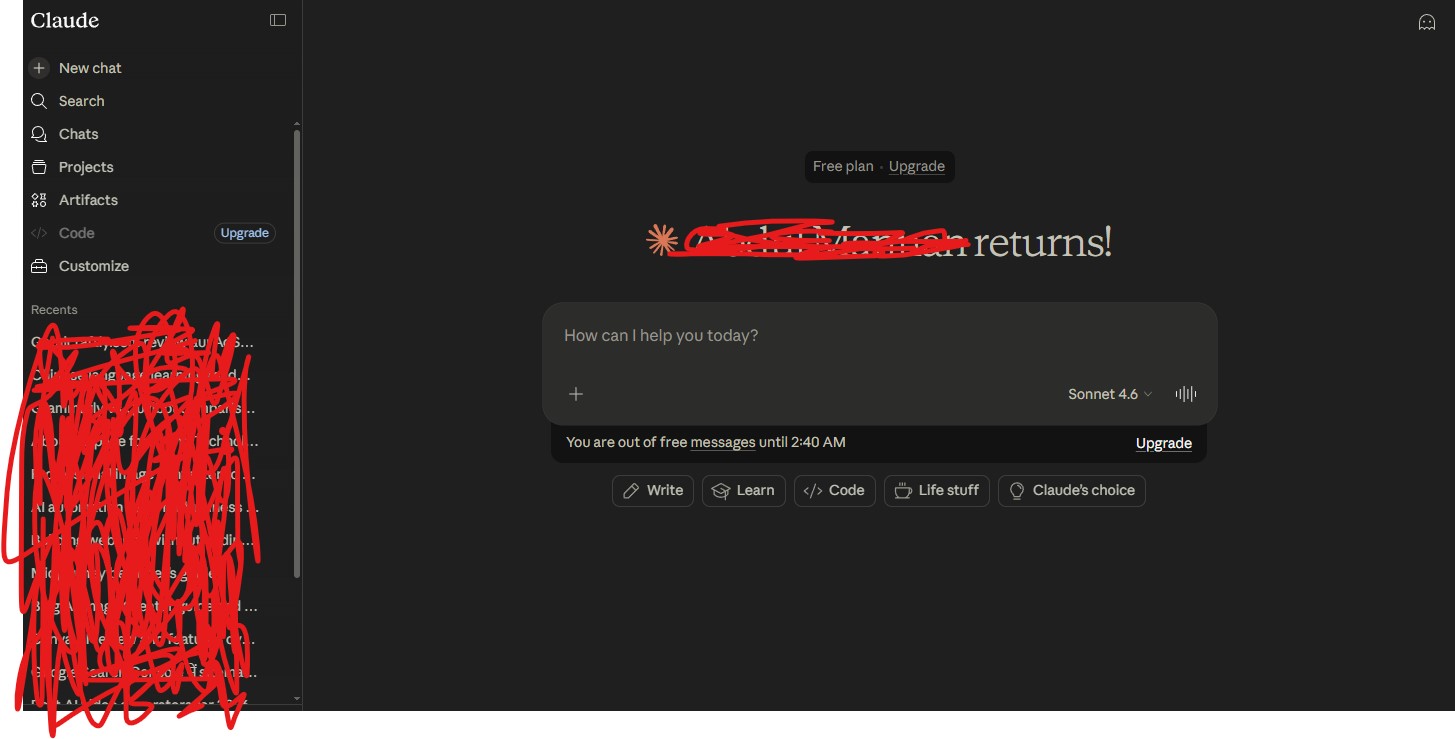
On the free plan, talks were set to Sonnet 4.5, which Anthropic recommends for everyday writing, editing, and reasoning jobs. Higher-end models, such as Opus 4.5 (built for more complex tasks) and Haiku 4.5 (tuned for faster, lighter replies), require an upgrade to access.
AI writing tools have progressed beyond the novelty phase. Most SEO specialists, marketers, and developers are increasingly more concerned with how to employ AI without sacrificing quality.
How Does Claude Work?
At the most basic level, Claude receives prompts and responds. It accomplishes this using large language models (LLMs) composed of artificial neural networks trained on vast volumes of data. These models are complex algorithms that enable Claude to acquire information on topics ranging from Peruvian food to Soviet architecture, finally answering your inquiries. Claude can also scan the internet for information about current events.
Claude is not like standard software in that Anthropic does not need to update it to make it better. Claude, like a person, may learn and grow with time. Simply speaking with Claude helps to train its underlying algorithms, providing you do not opt out of Anthropic training its models on your data. However, don’t expect Claude to switch from chat to chat right away—it’ll take time.
What is Claude AI, and how does it fare as an AI writing tool?
Claude is an AI assistant created by Anthropic, an AI company pitching itself as a thoughtful alternative to OpenAI. Claude is designed to be a conversational AI, which means that the focus is on interaction rather than dashboards, plugins, or automation rules.
This is relevant today since SEO and content creation are becoming more iterative. Professionals anticipate AI tools to:
- Maintain context across long conversations
- Handle follow-up questions naturally
- Improve output as the intent becomes clearer
Claude’s design fits in well with this transition. Rather than working as a text vending machine, Claude behaves more like a collaborative AI agent who works through challenges with you.
Claude AI writing in 2026: what long-form tests reveal
For this Claude AI writing tool review, I purposefully evaluated long-form writing with a forward-thinking topic: “How AI Writing Tools Will Continue to Change SEO Workflows in 2026.”
Claude wrote a well-structured, coherent article of almost 1,400 words without losing track of previous sections. That’s not a minor detail. Many huge language models still struggle with content longer than a few paragraphs.
What this signals for 2026 is important:
- Long-form content isn’t going away
- SEO still rewards depth and structure
- AI tools that can’t maintain coherence will fall behind
Claude conducted this test quietly and consistently, making it ideal for manuals, reviews, documentation, and editorial content—especially when humans are involved.
Using Claude AI for SEO rewrites and writing emails
SEO effort is not limited to long content. Much of it entails minor but crucial activities such as shortening paragraphs, editing meta content, or crafting social media messages with the appropriate tone.
In rewrite testing, Claude kept the meaning while enhancing clarity and flow. It avoided keyword cramming and did not reduce the language to something mechanical. Claude also revealed its logic, which can be useful during collaboration; nevertheless, you should encourage it to return only the final output.
To make this more tangible, I evaluated how Claude handles subtle tone adjustments, which are critical in SEO material and product evaluations.
Beginning with a neutral line like “Claude is an AI writing tool designed to assist users with content generation, research, and text refinement,” I requested Claude to rewrite it in a more conversational, mildly opinionated tone. The end result felt natural and accessible, with straightforward language (“you”), relevant wording, and a clear advantage that didn’t sound too commercial.
Pricing: Slightly Cheaper Than Competitors
For free, you may use Claude’s Sonnet model to answer questions, produce code, create apps, process files, search the web, and visualize data, among other things. A Pro plan ($17 per month, payable annually) includes Claude in your terminal, deep research, extended thinking for complex jobs, full integration support, increased usage restrictions, models beyond Sonnet 4, and infinite Projects for organizing chats and papers.
The top-tier Max package grants you preferential access to Claude during peak traffic hours and even larger usage limitations. Max is available in two flavors: 5x more usage than Pro ($100 per month, billed yearly), and 20x more usage than Pro ($200 per month, billed annually). You also have early access to new features, however none were available at the time of writing. The vast majority of consumers interested in premium plans, however, should choose the Pro plan, which has generous usage restrictions. For this evaluation, I mainly tested the Free and Max 5x tiers.
Chatbots typically cost $20 per month for a flagship premium subscription. Thus, Claude Pro’s $17-per-month charge provides some savings. The top plans from ChatGPT ($200 per month) and Gemini ($250 per month) are comparable to Claude’s most expensive Max plan, however Claude allows you to sign up for a lower-cost version of Max, which I love. However, Claude’s free plan misses several of the features available with ChatGPT and Gemini, such as deep research, image and video production, model swapping, and voice chat. In fact, Claude does not support image or video generation at all.
Where Is Claude Available?
Claude is available as a desktop app (for macOS and Windows), a mobile app (for Android and iOS), and a website. It has an official Chrome extension, but access is restricted to Max subscribers.
Other services and sites employ Claude’s models, such as Perplexity, however Anthropic does not create, maintain, or own these iterations, hence they are not part of the original Claude package. If you want to access all of Claude’s features, continue with the official apps and site.
Personal Experience
I used Claude AI every day for two weeks. I tried it out for writing blog posts summarizing research and getting answers to questions. It really impressed me. The responses seemed real and like they were put together with care. Claude AI gave answers than I thought it would. I was surprised by how natural the responses felt. The responses from Claude AI felt thoughtful.

James Eco is an AI tools researcher and content
creator with 3+ years of experience testing and
reviewing AI tools for creators and businesses.
At Get AI Craftly, he provides honest, hands-on
reviews to help readers choose the best AI tools.