Artificial Intelligence is changing the world we live in. Artificial Intelligence is really cool because it helps make things, like assistants that can talk to us. We also have self-driving cars that can take us places.. Even with all these great things a lot of people do not really know what Artificial Intelligence is. They also get Artificial Intelligence mixed up with Machine Learning and Deep Learning. Machine Learning and Deep Learning are related to Artificial Intelligence. They are not exactly the same thing. People should learn more about Artificial Intelligence, Machine Learning and Deep Learning so they can understand how these technologies are used in our lives.
These things are really not the same. Each technology has its special job and it is used in its own way. Some technology is very complicated. Some is not. If you know what makes each technology different you will understand technology better. You will know how technology works today and what technology will be like, in the future. Technology is always. It is good to know what is coming next with technology.
This guide is for anyone whether you are a beginner or a student or a business owner. It will explain everything about Artificial Intelligence, Machine Learning and Deep Learning in a simple way. By the time you finish reading this guide you will understand how Artificial Intelligence and Machine Learning and Deep Learning are related to each other. You will also know which one of these Artificial Intelligence or Machine Learning or Deep Learning is the important, for your needs.
Introduction to AI Machine Learning and Deep Learning
- Brief overview of the concepts
- Why people confuse these terms
Importance of understanding their differences
What is Artificial Intelligence (AI)?
- Definition and core idea
- Types of AI (Narrow, General, Super)
- Real-world applications
What is Machine Learning (ML)?
- Definition and how it works
- Key learning types (supervised, unsupervised, reinforcement)
- Common use cases
What is Deep Learning (DL)?
- Definition and relation to ML
- Role of neural networks
- Advantages and limitations
How AI Machine Learning and Deep Learning Are Related
- Hierarchical relationship (AI → ML → DL)
- Key similarities
- How they work together
Key Differences Between AI, ML, and DL
- Comparison based on:
- Data requirements
- Complexity
- Learning approach
- Human involvement
- Data requirements
Real-World Applications and Use Cases
- AI applications
- ML applications
- DL applications
When to Use AI vs Machine Learning vs Deep Learning
- Best scenarios for each
- Business and practical decision-making
Future Trends and Career Opportunities
- Growth of AI technologies
- Job roles (AI/ML/DL engineers)
- Skills required
Conclusion
- Summary of key points
- Final thoughts
What is Artificial Intelligence (AI)?
Artificial Intelligence or AI is when machines can think like humans. It helps computers learn and make choices. Computers can do these things faster and more accurately than humans. AI is all about machines copying intelligence. This way computers can make decisions, like humans do.
Artificial Intelligence is an idea that involves making systems that can do things that people can usually do. These things include understanding what people say recognizing pictures figuring out problems and even guessing what might happen. Artificial Intelligence is, about making systems that can think and do things like people do. Artificial Intelligence systems can understand language. Recognize images, which is really cool.
Core Concepts of AI
AI works by combining data, algorithms, and computing power. Instead of being explicitly programmed for every task, AI systems learn patterns from data and improve over time.
Some key capabilities of AI include:
- Learning: Gaining information from data
- Reasoning: Making decisions based on logic
- Perception: Understanding images, sounds, and text
Automation: Performing tasks without human intervention
Types of Artificial Intelligence
AI is generally divided into three main types based on its capabilities:
1. Narrow AI (Weak AI)
This is the most common form of AI today. It is designed to perform a specific task.
Examples include voice assistants, recommendation systems, and chatbots.
2. General AI (Strong AI)
This type of AI can perform any intellectual task that a human can do. It can think, reason, and learn across different domains.
Currently, this type of AI does not exist but is a major goal for researchers.
3. Super AI
This is a hypothetical future stage where AI surpasses human intelligence in all aspects.
It would be capable of creativity, decision-making, and emotional understanding beyond human level.
Real-World Applications of AI
AI is already a part of our daily lives. Some common applications include:
- Virtual Assistants: Like Siri and Google Assistant
- Recommendation Systems: Used by Netflix, YouTube, and Amazon
- Healthcare: Disease detection and medical diagnosis
- Finance: Fraud detection and automated trading
- Transportation: Self-driving cars and traffic prediction
What is Machine Learning (ML)?
Machine Learning is a part of Artificial Intelligence. It helps systems learn from data. They do not need to be told what to do. Machine Learning is about creating models. These models find patterns, in data. They make predictions. They make predictions. The models get better as they learn more. This learning happens over time. Machine Learning models improve. They learn from data.
In simple terms, ML teaches computers to learn from experience—just like humans do.
How Machine Learning Works
Machine Learning works by using a lot of information that we put into computer programs. These computer programs look at the information find things that’re similar and use those similar things to make choices or guesses about what might happen. Machine Learning is really good, at looking at all the information we give it and finding ways to make decisions. We use Machine Learning to help the computer programs get better at making choices.
The basic process includes:
- Data Collection: Gathering relevant data
- Training: Feeding data into the model
- Learning Patterns: Identifying relationships in data
- Prediction: Making decisions based on learned patterns
- Improvement: Getting better with more data over time
For example, an email spam filter learns from thousands of emails to identify which ones are spam and which are not.
Types of Machine Learning
Machine Learning can be divided into three main types based on how it learns:
1. Supervised Learning
The model is trained on labeled data. This means the correct output is already known.
Example: Predicting house prices based on past data.
2. Unsupervised Learning
The model works with unlabeled data and tries to find hidden patterns or groupings.
Example: Customer segmentation in marketing.3. Reinforcement Learning
The model learns by interacting with an environment. It receives rewards or penalties based on its actions.
Example: Training robots or game-playing AI systems.
Common Use Cases of Machine Learning
Machine Learning is widely used across different industries:
- Search Engines: Improving search results
- E-commerce: Product recommendations
- Finance: Fraud detection and risk analysis
- Healthcare: Predicting diseases and patient outcomes
- Social Media: Content personalization
What is Deep Learning (DL)?
Deep Learning is a part of Machine Learning. It uses algorithms called neural networks. These networks help computers learn from lots of data. The goal is to make computers work like the brain. Deep Learning tries to copy how we think and learn.
In simple terms, Deep Learning takes Machine Learning to the next level by handling complex tasks automatically—without much human input.
How Deep Learning Works
Deep Learning uses artificial neural networks, which are made up of multiple layers (hence the term “deep”). Each layer processes data and passes it to the next one, gradually improving the accuracy of the output.
Here’s how it works:
- Input Layer: Receives raw data (images, text, audio)
- Hidden Layers: Process and analyze patterns step by step
- Output Layer: Produces the final result
The more data the system gets, the better it becomes at recognizing patterns and making decisions.
Role of Neural Networks
Neural networks are the backbone of Deep Learning. They are inspired by the structure of the human brain, where neurons are connected and work together to process information.
These networks are especially powerful for tasks like:
- Image recognition
- Speech recognition
- Language translation
- Complex decision-making
For example, facial recognition systems use deep neural networks to identify people with high accuracy.
Advantages of Deep Learning
Deep Learning has several powerful benefits:
- High Accuracy: Performs better with large datasets
- Automation: Requires less manual feature selection
- Handles Complex Data: Works well with images, audio, and text
Continuous Improvement: Gets better with more data
Limitations of Deep Learning
Despite its strengths, Deep Learning also has some challenges:
- Data Hungry: Needs large amounts of data
- High Computing Power: Requires powerful hardware (GPUs)
- Less Transparency: Hard to understand how decisions are made
Time-Consuming: Training models can take a long time
How AI Machine Learning and Deep Learning Are Related
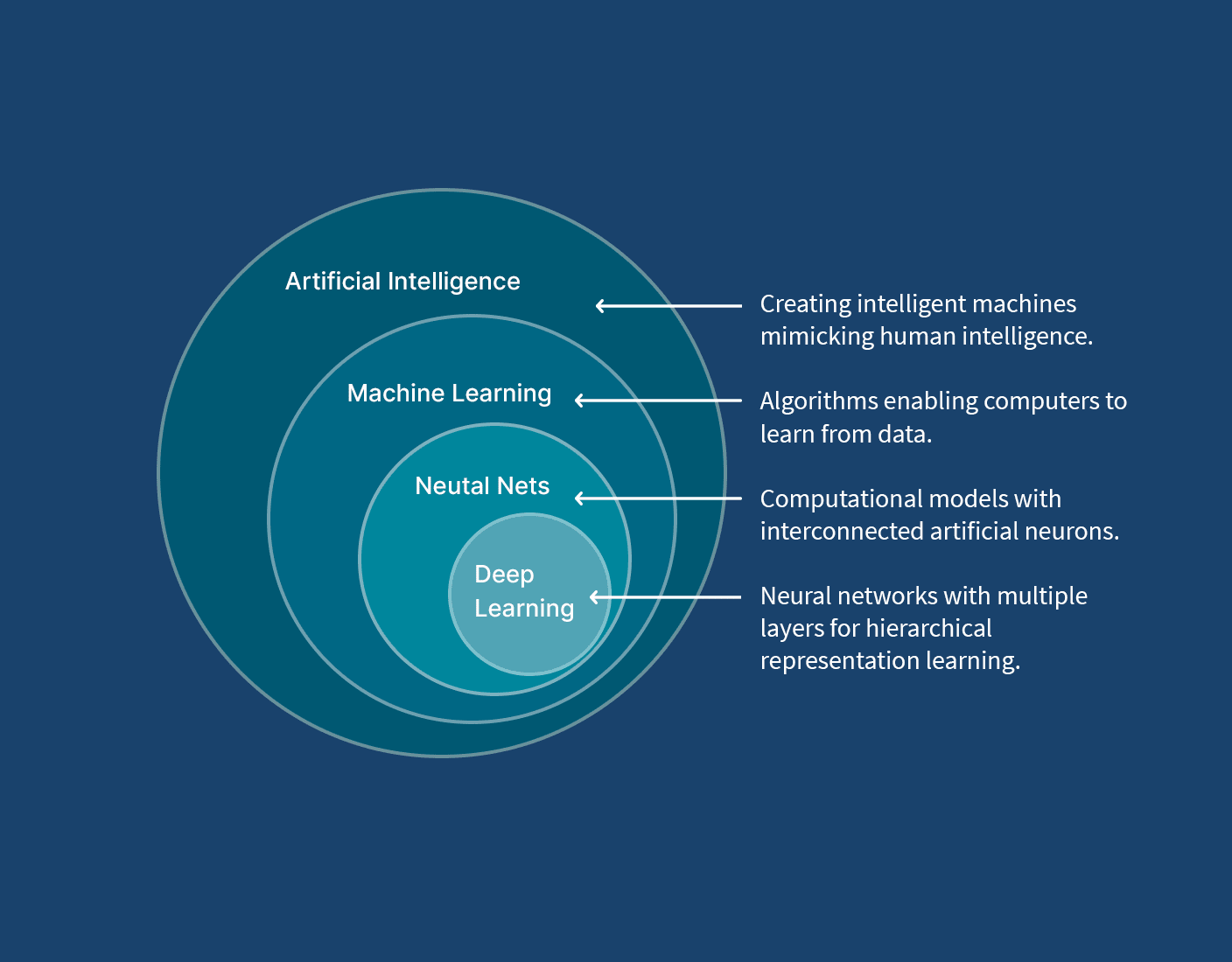
Artificial Intelligence, Machine Learning, and Deep Learning are closely connected. They are not separate technologies. Instead, they are layered within each other.
The easiest way to understand their relationship is to think of them as a hierarchy.
The Hierarchical Structure
- Artificial Intelligence (AI) is the broadest concept
- Machine Learning (ML) is a subset of AI
- Deep Learning (DL) is a subset of Machine Learning
This means:
- All Deep Learning is Machine Learning
- All Machine Learning is part of AI
But not all AI uses Machine Learning
How They Work Together
These technologies often work as a team rather than independently.
- AI provides the overall goal—making machines intelligent
- ML provides the learning ability—finding patterns in data
- DL provides advanced capabilities—handling complex tasks like images and speech
For example, in a voice assistant:
- AI enables the system to interact like a human
- ML helps it learn from user inputs
- DL helps it understand speech and language accurately
Key Similarities
Despite their differences, they share some common features:
- Data-Driven: All rely on data to function and improve
- Automation: Reduce the need for manual work
- Continuous Learning: Improve performance over time
Problem-Solving: Designed to make decisions and predictions
Simple Analogy to Understand
Think of it like this:
- AI is the entire system (the idea of smart machines)
- ML is the method (how machines learn)
- DL is the advanced technique (how machines handle complex tasks)
Or even simpler:
AI is the goal, ML is the approach, and DL is the powerful tool.
Key Differences Between AI, ML, and DL
Artificial Intelligence and Machine Learning and Deep Learning are. They are different things. Artificial Intelligence has its way of doing things. Machine Learning has its way of working and Deep Learning has its own way of working too.
Understanding how Artificial Intelligence works and how Machine Learning works and how Deep Learning works will help you see how these smart systems work today.
1. Scope and Definition
- Artificial Intelligence (AI):
The broad concept of creating machines that can perform tasks requiring human intelligence. - Machine Learning (ML):
A subset of AI that focuses on enabling machines to learn from data. - Deep Learning (DL):
A subset of ML that uses neural networks to handle complex tasks.
In short: AI > ML > DL
2. Data Requirements
- AI: Can work with smaller datasets and predefined rules
- ML: Requires structured data to learn effectively
- DL: Needs massive amounts of data to perform well
Deep Learning systems improve significantly as more data becomes available, while traditional AI may rely more on logic and rules.
3. Complexity Level
- AI: Can be simple or complex depending on the system
- ML: More complex than basic AI due to learning mechanisms
- DL: Highly complex due to multi-layered neural networks
Deep Learning models often require advanced architectures and significant computational power.
4. Learning Approach
- AI: May follow rule-based programming or learning-based methods
- ML: Learns patterns from data using algorithms
- DL: Automatically learns features and patterns without human intervention
This makes Deep Learning more autonomous compared to traditional Machine Learning.
5. Human Involvement
- AI: High human involvement in rule creation
- ML: Moderate involvement (feature selection and model tuning)
- DL: Minimal involvement (automated feature extraction)
As you move from AI to DL, the need for manual input decreases.
6. Handling of Data Types
- AI: Works well with structured data and predefined inputs
- ML: Handles structured and some unstructured data
- DL: Excels at unstructured data like images, audio, and text
This is why Deep Learning is widely used in advanced applications like image recognition and natural language processing.
7. Performance and Accuracy
- AI: Good for simple decision-making tasks
- ML: More accurate with data-driven predictions
- DL: Highest accuracy in complex scenarios
However, better performance in DL often comes at the cost of higher resources and longer training time.
Quick Comparison Summary
| Feature | AI | Machine Learning | Deep Learning |
| Scope | Broad | Subset of AI | Subset of ML |
| Data Requirement | Low to Medium | Medium | High |
| Complexity | Low to High | Medium | Very High |
| Human Involvement | High | Medium | Low |
| Best For | Basic automation | Data-driven tasks | Complex problems |
Real-World Applications and Use Cases
Artificial Intelligence and Machine Learning and Deep Learning are not ideas that people talk about. They are actually used in systems that affect our daily lives and the way businesses work today. Artificial Intelligence and Machine Learning and Deep Learning are changing things.
Each technology has its own strengths, which makes it suitable for different types of applications.
Applications of Artificial Intelligence (AI)
AI is widely used for automation and decision-making tasks. It often combines rules, logic, and learning systems to solve problems.
Common AI applications include:
- Virtual Assistants: Tools like Siri and Alexa that respond to voice commands
- Customer Support Chatbots: Automated responses for user queries
- Smart Home Devices: Controlling lights, security, and appliances
- Fraud Detection Systems: Identifying suspicious financial activities
- Game AI: Creating intelligent opponents in video games
AI is best suited for systems that require decision-making and automation.
Applications of Machine Learning (ML)
Machine Learning is used when systems need to analyze data and make predictions.
Popular ML use cases include:
- Recommendation Systems: Suggesting products on Amazon or videos on YouTube
- Email Spam Filtering: Classifying emails as spam or not
- Predictive Analytics: Forecasting sales, trends, or risks
- Healthcare Predictions: Identifying diseases based on patient data
- Stock Market Analysis: Predicting price movements
ML is ideal for data-driven tasks where patterns and trends matter.
Applications of Deep Learning (DL)
Deep Learning is used for complex problems involving unstructured data like images, audio, and text.
Key DL applications include:
- Image Recognition: Facial recognition and object detection
- Speech Recognition: Voice-to-text systems
- Natural Language Processing (NLP): Chatbots and translation tools
- Self-Driving Cars: Understanding surroundings in real time
- Medical Imaging: Detecting diseases from X-rays and scans
Deep Learning shines in scenarios where high accuracy and complex data processing are required.
How Businesses Use AI, ML, and DL Together
In many real-world systems, these technologies are combined:
- AI handles overall decision-making
- ML analyzes data and improves performance
- DL processes complex inputs like images and voice
For example, in an e-commerce platform:
- AI manages the system and user experience
- ML recommends products
- DL analyzes images and customer behavior
When to Use AI vs Machine Learning vs Deep Learning
When you are trying to decide between Artificial Intelligence and Machine Learning and Deep Learning you have to think about what you want to achieve the kind of data you have and how complicated your problem is. Artificial Intelligence has some things about it Machine Learning has some good things about it and Deep Learning has some good things, about it. If you use the one it can save you a lot of time it can save you a lot of money and it can save you a lot of work.
When to Use Artificial Intelligence (AI)
AI is the best choice when you need systems that can make decisions, automate tasks, or simulate human behavior.
Use AI when:
- You want to automate rule-based processes
- The problem does not require large datasets
- You need logical decision-making systems
- You are building chatbots or simple automation tools
Example:
A customer support chatbot that follows predefined responses and workflows.
AI works well for simple to moderately complex tasks where rules and logic are enough.
When to Use Machine Learning (ML)
Machine Learning is ideal when your system needs to learn from data and improve over time.
Use ML when:
- You have structured data available
- The problem involves predictions or pattern recognition
- You want the system to learn and adapt automatically
- Manual rule creation is too complex or inefficient
Example:
A recommendation system that suggests products based on user behavior.
ML is best for data-driven problems where patterns are not obvious.
When to Use Deep Learning (DL)
Deep Learning is the right choice for highly complex problems involving large-scale and unstructured data.
Use DL when:
- You are working with images, audio, or text data
- The problem requires high accuracy
- You have access to large datasets and strong computing power
- Traditional ML methods are not performing well
Example:
Facial recognition systems or voice assistants that understand natural language.
DL is best for advanced applications where complexity is very high.
Quick Decision Guide
- Choose AI → for rule-based automation and decision systems
- Choose ML → for learning from structured data and making predictions
- Choose DL → for handling complex data like images, speech, and language
Business Perspective
From a business point of view:
- Start with AI for automation
- Use ML when you have data to gain insights
- Move to DL when you need cutting-edge performance and innovation
Future Trends and Career Opportunities
Artificial Intelligence is changing fast. Machine Learning and Deep Learning are too. They are changing the way things work in industries. They are helping to create technologies and new jobs. If you want to be good at Artificial Intelligence and Machine Learning and Deep Learning you should try to learn about what’s coming next. This will help you be ahead of others, in the world of Artificial Intelligence and Machine Learning and Deep Learning.
Emerging Trends in AI, ML, and DL
- Generative AI
- AI systems that can create content like text, images, and music.
- Examples include ChatGPT for text and DALL·E for images.
- Expected to transform content creation, marketing, and design.
- AI systems that can create content like text, images, and music.
- Explainable AI (XAI)
- AI systems are becoming more transparent.
- Businesses are demanding AI that explains its decisions.
- Critical for healthcare, finance, and law where accountability matters.
- AI systems are becoming more transparent.
- AI in Edge Computing
- AI is moving from centralized servers to devices (edge AI).
- Enables real-time processing in IoT devices, smartphones, and autonomous vehicles.
- AI is moving from centralized servers to devices (edge AI).
- Advanced Automation
- AI, ML, and DL are automating complex tasks across industries.
- Examples include predictive maintenance in manufacturing and automated trading in finance.
- AI, ML, and DL are automating complex tasks across industries.
- Integration of AI with Other Technologies
- Combining AI with AR/VR, blockchain, and robotics is creating new business models.
- This integration is driving smarter products and services.
- Combining AI with AR/VR, blockchain, and robotics is creating new business models.
Career Opportunities
The rise of AI, ML, and DL has created high-demand roles in the technology sector:
- AI Engineer – Designs intelligent systems and algorithms
- Machine Learning Engineer – Builds predictive models and trains ML systems
- Deep Learning Specialist – Develops neural networks for complex tasks
- Data Scientist – Analyzes data to extract actionable insights
- AI Product Manager – Oversees AI projects from concept to implementation
Skills in Demand:
- Programming: Python, R, Java
- ML/DL frameworks: TensorFlow, PyTorch, Keras
- Data handling: SQL, NoSQL, Big Data tools
Cloud computing: AWS, Google Cloud, Azure
Why Learning AI, ML, and DL is Worth It
- High Demand: Companies are actively seeking talent in AI, ML, and DL.
- Competitive Salaries: These roles often offer top-paying tech positions.
- Impactful Work: You can work on projects that influence healthcare, finance, transportation, and more.
Continuous Innovation: The field is constantly evolving, offering opportunities to learn and grow.
AI Machine Learning and Deep Learning are not the technologies we use today they are actually shaping what the future will be, like. If you understand the trends of Artificial Intelligence and Machine Learning and Deep Learning and the potential careers they offer you can position yourself in a field that will become more important in the years to come. Artificial Intelligence and Machine Learning and Deep Learning will only get bigger.
Conclusion
Artificial Intelligence is changing the way we live work and interact with technology. Machine Learning is also doing the thing. Deep Learning is doing it too. These things are often used in the conversation but Artificial Intelligence, Machine Learning and Deep Learning each do their own thing.
- AI is the broad field of creating intelligent systems.
- Machine Learning teaches systems to learn from data.
- Deep Learning handles complex tasks with neural networks.
When you know the differences, between these things you can make choices. You can make choices when you are learning about these technologies or when you are building things that use artificial intelligence or when you are using them for your business. The technologies are important and understanding them is key. You will be using these technologies to make your business better. It is good that you understand the technologies.
The future of technology is really smart. Technology, like Artificial Intelligence, Machine Learning and Deep Learning will keep changing the way we do things in industries create new jobs and fix problems that we could not fix before. If you keep learning about Artificial Intelligence, Machine Learning and Deep Learning and make the most of these tools you can do well in a world where machines and data are becoming more important.
James Eco is an AI tools researcher and content
creator with 3+ years of experience testing and
reviewing AI tools for creators and businesses.
At Get AI Craftly, he provides honest, hands-on
reviews to help readers choose the best AI tools.