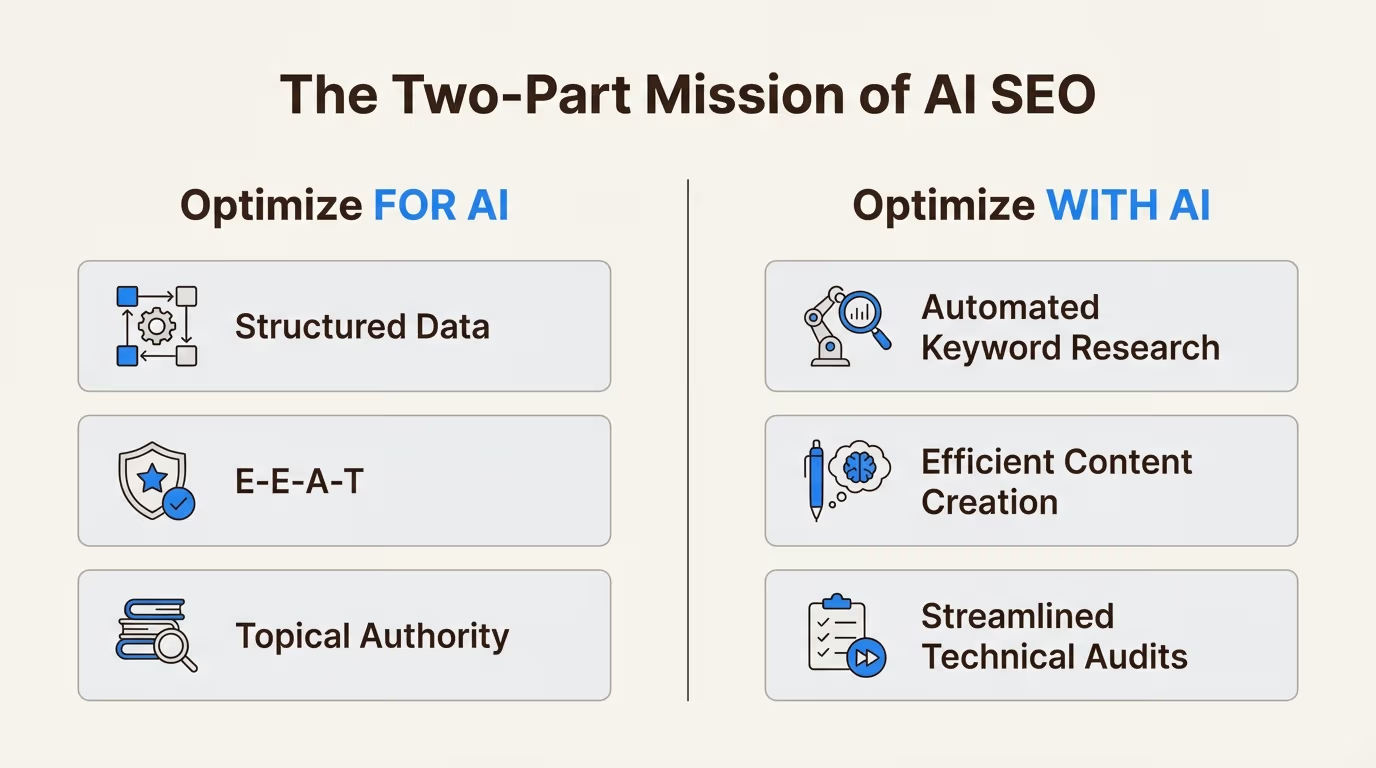
Artificial intelligence is changing how search engines work and how content ranks. AI SEO Guide is no longer just about keywords and backlinks. It now depends on understanding user intent, data, and content quality at a deeper level.
Search engines are getting smarter. They can evaluate context, relevance, and usefulness more accurately than ever. This means low-quality or mass-produced content struggles to rank, even if it is optimized.
At the same time, AI tools are helping creators work faster. From keyword research to content writing, many SEO tasks can now be automated or improved with AI.
Google’s Perspective on AI-Generated Content
Search engines, especially Google, do not focus on how content is created. Their priority is the quality and usefulness of the content. Whether it’s written by humans or generated with AI, the goal is the same: deliver value to users.
Focus on Quality Over Creation Method
Google’s ranking systems are designed to reward helpful, reliable, and people-first content. This means:
- Content must answer real user queries
- Information should be accurate and trustworthy
- Pages should provide a satisfying user experience
AI-generated content is not automatically penalized. However, content created purely to manipulate rankings—without real value—is likely to perform poorly.
In simple terms, quality matters more than the tool used to create it.
Role of Automation in Content Creation
Automation has been part of SEO for years. AI is just a more advanced version of it. Google recognizes that automation can be useful when used responsibly.
Examples of acceptable automation include:
- Generating product descriptions at scale
- Creating data-driven reports
- Assisting with content drafts and outlines
However, problems arise when automation is used to:
- Mass-produce low-quality articles
- Publish unverified or misleading information
- Create content with no human oversight
The key difference is intent. Helpful automation is acceptable. Spammy automation is not.
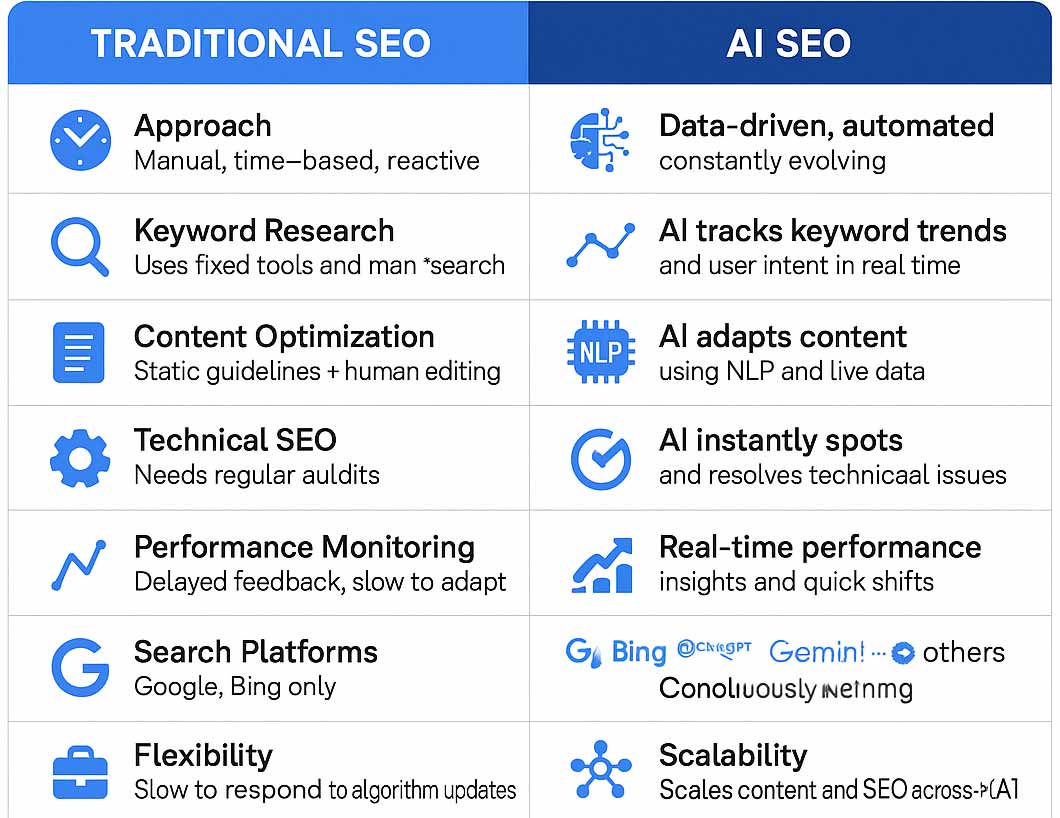
Key Guidelines for Creators Using AI
If you’re using AI tools for SEO, follow these principles to stay aligned with Google’s expectations:
1. Prioritize People-First Content
Write for users, not search engines. Content should solve problems and provide clear answers.
2. Add Human Review and Expertise
AI can assist, but human input ensures accuracy, depth, and originality.
3. Maintain E-E-A-T Standards
Content should reflect Experience, Expertise, Authoritativeness, and Trustworthiness.
4. Avoid Scaled Spam Content
Publishing large volumes of low-value pages can harm rankings.
5. Ensure Accuracy and Credibility
Always fact-check AI-generated information before publishing.
What This Means for SEO Strategy
Using AI can improve efficiency, but it doesn’t replace quality. Google’s systems are becoming better at identifying content that lacks depth or authenticity.
What AI SEO Really Means
AI SEO is not just about using tools to generate content. It is a smarter, data-driven approach to optimizing websites using artificial intelligence. Instead of relying only on manual work, AI helps analyze patterns, predict outcomes, and improve decisions at scale.
Definition and Core Concept
AI SEO refers to the use of machine learning and automation to improve search engine optimization. It enhances how you:
- Research keywords
- Create and optimize content
- Analyze competitors
- Fix technical SEO issues
At its core, AI SEO is about making faster and more accurate decisions based on data. It reduces guesswork and replaces it with insights.
Search engines like Google already use AI in their algorithms. This includes systems like RankBrain and BERT, which help understand search intent and content relevance.
So, AI SEO is not just a trend. It aligns your strategy with how modern search engines actually work.
How AI Integrates into SEO Workflows
AI can be applied across almost every stage of SEO. It acts as an assistant that improves speed and accuracy.
1. Research Phase
AI tools analyze massive datasets to find keyword opportunities, search trends, and user intent patterns.
2. Content Creation
AI helps generate outlines, drafts, and topic ideas. It ensures content aligns with what users are searching for.
3. Optimization
AI suggests improvements like keyword placement, readability, and structure based on top-ranking pages.
4. Technical SEO
It detects issues such as broken links, slow pages, or missing metadata much faster than manual audits.
5. Performance Analysis
AI tracks rankings, traffic, and user behavior to provide actionable insights and predictions.
Why AI SEO Matters Today
Traditional SEO methods are no longer enough. Search engines are smarter, competition is higher, and data is growing rapidly.
AI helps you:
- Keep up with changing algorithms
- Process large amounts of data quickly
- Make informed decisions instead of guessing
- Scale your SEO efforts efficiently
Key Applications of AI in SEO
AI is not limited to one part of SEO. It supports multiple areas, making optimization faster, smarter, and more precise. Below are the most important ways AI is applied in modern SEO strategies.
Content Creation and Optimization
AI helps streamline content production without starting from scratch every time.
- Generates topic ideas based on search trends
- Creates outlines and first drafts quickly
- Improves readability and structure
- Suggests keyword placement and content gaps
Tools like ChatGPT and Surfer SEO assist in aligning content with what already ranks.
However, human editing remains essential to ensure accuracy and originality.
Keyword Research and Clustering
Keyword research becomes more powerful with AI. Instead of manual analysis, AI processes large datasets instantly.
- Finds high-volume and low-competition keywords
- Identifies long-tail keyword opportunities
- Groups related keywords into clusters
- Understands search intent behind queries
Platforms such as Semrush use AI to uncover patterns that are hard to detect manually.
This helps create content that targets multiple related queries instead of just one keyword.
Technical SEO and Site Audits
AI improves technical SEO by quickly identifying issues that affect rankings.
- Detects broken links and crawl errors
- Analyzes page speed and performance
- Identifies indexing problems
- Suggests improvements for site structure
Tools like Screaming Frog SEO Spider automate site audits and provide actionable fixes.
This reduces the time needed for manual checks and ensures your site stays optimized.
Data Analysis and Performance Insights
SEO involves large amounts of data. AI helps turn this data into useful insights.
- Tracks keyword rankings and traffic trends
- Analyzes user behavior and engagement
- Predicts future performance
- Recommends data-backed strategies
With tools like Google Analytics, AI helps you understand what’s working and what needs improvement.
Why These Applications Matter
Each of these applications improves a specific part of SEO, but together they create a powerful system.
AI allows you to:
- Save time on repetitive tasks
- Make better decisions using data
- Scale your SEO efforts efficiently
Benefits of Using AI for SEO
AI brings measurable advantages to SEO. It reduces manual effort, improves accuracy, and helps teams achieve better results in less time. Below are the key benefits explained in detail.
Dramatic Efficiency Gains
AI automates repetitive and time-consuming tasks.
- Keyword research that once took hours can be done in minutes
- Content outlines and drafts are generated instantly
- Technical audits run automatically
Tools like ChatGPT and Semrush speed up workflows without sacrificing quality.
This allows you to focus more on strategy rather than routine tasks.
Scalability Without Proportional Resource Investment
AI makes it easier to scale SEO efforts without increasing team size.
- Produce more content in less time
- Manage large websites efficiently
- Expand into multiple keyword clusters
For growing websites, this means you can increase output without hiring a large team.
However, scaling should still be controlled to maintain quality.
Data-Driven Insights Humans Miss
AI processes massive datasets and identifies patterns that are hard to detect manually.
- Finds hidden keyword opportunities
- Detects trends before they become competitive
- Analyzes user behavior at a deeper level
Platforms like Google Analytics provide insights that help refine SEO strategies.
This leads to smarter decisions based on real data, not assumptions.
Consistency in Optimization
Maintaining consistency across content is challenging, especially at scale. AI helps standardize SEO practices.
- Ensures proper keyword usage
- Maintains consistent tone and structure
- Applies optimization rules across all pages
Tools like Surfer SEO guide content to meet ranking standards consistently.
This improves overall site quality and performance.
Cost-Effectiveness for Growing Teams
AI reduces the need for large teams and expensive resources.
- Fewer hours spent on manual work
- Reduced dependency on multiple specialists
- Better output with lower operational cost
While some tools require investment, they often deliver a strong return by improving productivity and results.
Why These Benefits Matter
AI does not replace SEO professionals, but it enhances their capabilities.
By combining speed, scalability, and data-driven insights, AI helps you:
- Compete in a crowded search landscape
- Improve rankings more efficiently
- Achieve better results with fewer resources
Common Challenges and Risks of AI SEO
AI can significantly improve SEO performance, but it is not without risks. If used incorrectly, it can harm rankings, reduce content quality, and damage credibility. Understanding these challenges helps you avoid costly mistakes.
Content Quality Concerns
AI-generated content can sometimes lack depth and originality.
- It may produce generic or repetitive information
- Complex topics may be oversimplified
- Content can miss real-world experience or insights
Search engines like Google prioritize helpful, people-first content. Thin or low-value pages often fail to rank.
Solution: Always review and enhance AI content with human expertise.
Risk of Inaccurate or Misleading Information
AI tools rely on existing data, which may not always be accurate or up to date.
- Facts can be incorrect or outdated
- Statistics may be misrepresented
- Sensitive topics may lack proper context
This can damage your site’s trust and authority.
Solution: Fact-check all information before publishing, especially for important topics.
Over-Automation and Lack of Human Input
Relying too heavily on AI can lead to poor results.
- Content may feel robotic or unnatural
- Brand voice can become inconsistent
- Important nuances may be missed
SEO still requires human judgment, creativity, and strategic thinking.
Solution: Use AI as a support tool, not a replacement.
Risk of Scaled Low-Quality Content
AI makes it easy to publish large volumes of content quickly. This can be risky if quality is ignored.
- Mass-produced pages may offer little value
- Duplicate or similar content can appear across pages
- Search engines may treat this as spam
This can lead to ranking drops or reduced visibility.
Solution: Focus on quality over quantity. Publish only valuable and unique content.
Difficulty in Understanding Search Intent
AI may not always fully understand user intent behind a query.
- Content may target the wrong audience
- Search intent (informational, transactional, etc.) may be misinterpreted
- Pages may fail to satisfy user expectations
This reduces engagement and ranking potential.
Solution: Validate AI outputs by analyzing real search results and user behavior.
Ethical and Transparency Concerns
Using AI raises questions about transparency and authenticity.
- Should users know content is AI-assisted?
- Is the content truly original?
- Does it reflect real expertise?
While AI use is not prohibited, misleading users can harm trust.
Solution: Be transparent when necessary and ensure content reflects genuine value.
Why These Risks Matter
AI can amplify both strengths and weaknesses. If used responsibly, it boosts performance. If misused, it can damage your SEO efforts.
To stay safe:
- Combine AI efficiency with human oversight
- Focus on accuracy and usefulness
- Follow search engine guidelines consistently
Best Practices for Using AI in SEO
Using AI effectively in SEO requires a balanced approach. It’s not about replacing human effort but enhancing it. Following the right practices ensures better rankings, higher-quality content, and long-term success.
Combine AI with Human Expertise
AI can generate ideas and drafts, but it lacks real-world experience and judgment.
- Use AI for research, outlines, and initial drafts
- Add human insights, examples, and expertise
- Refine tone, clarity, and depth manually
Search engines like Google value content that demonstrates real experience and authority.
Key takeaway: AI speeds up the process, but humans make the content valuable.
Focus on People-First Content
Content should always be created for users, not just for rankings.
- Answer real questions clearly
- Provide practical and actionable information
- Avoid keyword stuffing or forced optimization
AI can help structure content, but the goal should always be helpfulness and relevance.
Ensure Accuracy and Fact-Checking
AI-generated content is not always reliable.
- Verify facts, statistics, and claims
- Cross-check information with trusted sources
- Update outdated or incorrect data
This is especially important for topics related to health, finance, or major decisions.
Maintain Originality and Avoid Duplication
AI may produce content similar to existing material.
- Rewrite and personalize AI-generated text
- Add unique insights and perspectives
- Avoid publishing duplicate or near-duplicate pages
Original content performs better and builds trust with users.
Use AI for Data-Driven Optimization
AI excels at analyzing large datasets.
- Identify keyword opportunities
- Optimize content structure and readability
- Improve on-page SEO elements
Tools like Semrush and Surfer SEO help refine content based on real search data.
Avoid Over-Automation
Publishing large amounts of AI content without control can harm your site.
- Do not rely entirely on automated publishing
- Review every piece of content before going live
- Focus on quality instead of quantity
Balanced use of AI leads to better long-term results.
Align with Search Engine Guidelines
AI usage should follow established SEO principles.
- Avoid creating content just to manipulate rankings
- Ensure transparency and credibility
- Focus on E-E-A-T (Experience, Expertise, Authoritativeness, Trustworthiness)
Staying aligned with guidelines helps protect your site from penalties.
Continuously Monitor and Improve
SEO is an ongoing process, and AI can help track performance.
- Analyze traffic and ranking changes
- Identify what works and what doesn’t
- Update and improve content regularly
Tools like Google Analytics provide insights to guide improvements.
Why These Practices Matter
AI can be a powerful asset, but only when used correctly. By combining automation with human expertise and focusing on quality, you can:
- Build trust with your audience
- Improve search rankings
- Create sustainable SEO growth
Practical Ways to Use AI for SEO
AI can be applied directly to everyday SEO tasks. When used correctly, it reduces workload, improves accuracy, and speeds up execution. Below are the most practical and effective use cases.
Idea Generation and Topic Research
Coming up with fresh content ideas is often the hardest part of SEO. AI simplifies this process.
- Generates topic suggestions based on search trends
- Identifies questions users are asking online
- Finds content gaps in your niche
Tools like ChatGPT can quickly produce topic lists based on your industry. This helps you build a strong content pipeline without manual brainstorming.
Keyword Analysis and SERP Insights
AI improves keyword research by analyzing large amounts of search data.
- Finds high-volume and low-competition keywords
- Groups related keywords into clusters
- Analyzes search intent behind queries
- Studies top-ranking pages in search results
Platforms like Semrush help identify what is already ranking and why. This allows you to target keywords with higher chances of success.
Content Drafting and Structuring
AI speeds up the writing process by creating structured content drafts.
- Generates outlines for blog posts
- Writes first drafts for articles
- Suggests headings and subheadings
- Improves readability and flow
You can then refine the output by adding real examples, data, and brand-specific insights. This ensures content remains high-quality and original.
On-Page Optimization
AI helps improve how content is optimized for search engines.
- Suggests keyword placement in headings and body text
- Improves meta titles and descriptions
- Enhances readability and content structure
- Identifies missing SEO elements
Tools like Surfer SEO analyze top-ranking pages and guide you in optimizing your content to match or exceed them.
Internal Linking Strategy
Internal linking is important for SEO but often overlooked.
- AI suggests relevant internal links across your website
- Identifies orphan pages with no links
- Improves site structure and navigation
This helps search engines crawl your site more effectively and improves user experience.
Content Updates and Refreshing
Old content can lose rankings over time. AI helps identify and improve it.
- Finds outdated pages that need updates
- Suggests new keywords to add
- Rewrites sections for better relevance
- Improves overall content quality
Regular updates help maintain and improve rankings over time.
Performance Tracking and Optimization
AI helps monitor SEO performance continuously.
- Tracks keyword rankings and traffic changes
- Identifies pages losing visibility
- Suggests optimization opportunities
- Predicts future performance trends
Using tools like Google Analytics allows you to make data-driven improvements.
AI Tools for SEO in 2026
AI SEO Guides have become essential for modern digital marketing. They help automate research, optimize content, and improve rankings faster than traditional methods. In 2026, these tools are more advanced, offering deeper insights and smarter recommendations.
Overview of Popular AI SEO Guides
There are many tools available, each serving different purposes in SEO workflows.
- Keyword research and competitor analysis tools
- Content optimization platforms
- Technical SEO audit tools
- All-in-one SEO platforms
Some widely used tools include Semrush, Surfer SEO, and ChatGPT.
Each tool focuses on a different part of the SEO process, but together they create a complete optimization system.
Key Features to Look For
Not all AI SEO Guides offer the same value. The best ones usually include:
- Keyword discovery and clustering
- Content optimization suggestions
- SERP and competitor analysis
- Technical SEO auditing
- AI-generated content assistance
- Performance tracking and reporting
Tools that combine multiple features are often more efficient and cost-effective.
How AI SEO Guides Work
AI SEO Guides use machine learning and large datasets to analyze search behavior.
- They study top-ranking pages in search engines
- Identify patterns in keywords and content structure
- Suggest improvements based on real-time data
- Predict what content is more likely to rank
Search engines like Google already use similar AI systems in ranking algorithms, which is why these tools are so effective.
Choosing the Right AI SEO Guide
Selecting the right tool depends on your goals and budget.
- For content optimization: Surfer SEO is widely used
- For all-in-one SEO: Semrush is a strong option
- For content generation: ChatGPT is commonly used
Consider:
- Ease of use
- Accuracy of insights
- Integration with other tools
- Pricing and scalability
Benefits of Using AI SEO Guides
Using these tools provides several advantages:
- Faster keyword research and analysis
- Better content optimization
- Improved decision-making based on data
- Reduced manual SEO workload
They help marketers focus more on strategy instead of repetitive tasks.
Limitations to Keep in Mind
Despite their power, AI SEO Guides are not perfect.
- They may generate generic suggestions
- They cannot fully replace human creativity
- Over-reliance can lead to low-quality content
- Some insights still require manual verification
Human review remains essential for accuracy and originality.
Why AI SEO Guides Are Essential Today
SEO has become highly competitive and data-driven. Manual methods alone are no longer enough.
AI SEO Guides help you:
- Stay competitive in search rankings
- Work more efficiently
- Make smarter, data-backed decisions
- Scale content and optimization efforts
AI-Assisted SEO Competitor Analysis
Competitor analysis is one of the most important parts of SEO. It helps you understand what is already working in your niche and where you can outperform others. AI makes this process faster, deeper, and more structured.
Instead of manually reviewing websites, AI can process large datasets and highlight actionable insights in minutes.
Data Collection and Analysis Process
The first step in competitor analysis is gathering data. AI tools simplify this by extracting key SEO metrics automatically.
You can analyze:
- Top-ranking pages in your niche
- High-traffic keywords competitors are targeting
- Content structure and length
- Backlink profiles and authority signals
Tools like Semrush help collect this data efficiently and present it in a structured format.
This removes the need for time-consuming manual research.
Identifying Content and Keyword Gaps
Once data is collected, AI helps identify opportunities you are missing.
- Keywords competitors rank for but you don’t
- Topics that drive high traffic in your niche
- Content areas with weak competition
- Pages that can be improved or expanded
AI groups these findings into clusters, making it easier to prioritize opportunities.
Tools such as ChatGPT can also help interpret this data and suggest content strategies based on gaps.
SERP and Intent Analysis
Understanding search intent is critical for ranking.
AI analyzes search engine results pages (SERPs) to determine:
- Whether users want informational or transactional content
- What type of content ranks (blogs, videos, product pages)
- Common patterns in top-performing pages
Search engines like Google prioritize content that matches user intent closely.
AI helps you align your content with what users actually expect.
Competitor Content Breakdown
AI can break down competitor content to reveal why it ranks.
- Headings and structure used in top pages
- Keyword density and placement
- Use of visuals, tables, or FAQs
- Content depth and readability
This helps you understand what makes their content successful and how to improve your own.
Prioritizing Opportunities
Not all SEO gaps are equally valuable. AI helps prioritize based on impact.
- High-traffic keyword opportunities
- Low-competition but high-value topics
- Quick wins with high ranking potential
- Long-term strategic content ideas
This ensures you focus on changes that deliver the best results first.
Validating AI Insights with Human Judgment
AI provides suggestions, but human review is essential.
- Check if keyword opportunities are relevant
- Ensure content ideas match your audience
- Validate search intent accuracy
- Remove low-quality or irrelevant suggestions
This combination ensures both accuracy and strategic alignment.
Turning Insights into Actionable Strategy
The final step is converting analysis into a clear SEO plan.
- Create content briefs based on gaps
- Build topic clusters around key themes
- Improve existing pages with better optimization
- Target keywords with the highest ROI potential
This step transforms raw data into real growth opportunities.
Why AI Competitor Analysis Matters
Traditional competitor research is slow and limited. AI changes that by providing:
- Faster data processing
- Deeper keyword and content insights
- Better prioritization of opportunities
- Smarter decision-making
Cost and ROI of AI SEO Guides
AI SEO Guides come in different price ranges, from free utilities to advanced enterprise platforms. Understanding costs and return on investment (ROI) is important before choosing the right tool for your strategy.
Free vs Paid AI SEO Guides
AI SEO Guides are generally divided into two categories: free and paid.
Free tools usually offer limited features:
- Basic keyword research
- Simple content generation
- Limited SEO analysis
Examples include entry-level versions of tools like ChatGPT and free analytics features in Google Analytics.
These are useful for beginners but often lack depth and scalability.
Paid tools offer advanced capabilities:
- Full keyword research suites
- Competitor analysis and SERP tracking
- AI-driven content optimization
- Technical SEO auditing
Platforms like Semrush and Surfer SEO fall into this category.
They are designed for professionals and businesses that need consistent SEO performance.
Typical Pricing Ranges
AI SEO Guide pricing varies based on features and scale.
- Basic plans: Affordable, suitable for individuals or small websites
- Mid-tier plans: Designed for growing businesses and agencies
- Enterprise plans: Advanced features for large-scale operations
Pricing depends on:
- Number of keywords tracked
- Number of projects or websites
- Access to AI features and integrations
- Level of data depth and reporting
More powerful tools naturally come with higher costs.
Factors That Affect Cost
Several factors influence how much you will spend on AI SEO Guides:
- Feature set: Advanced AI analysis costs more
- Data volume: Larger websites require higher-tier plans
- User access: Team collaboration increases pricing
- Automation level: More automation usually means higher cost
Choosing the right plan depends on your SEO goals and website size.
ROI Considerations
The real value of AI SEO Guides is not just cost—it’s return on investment.
AI tools can help you:
- Save time on keyword research and content creation
- Improve rankings through better optimization
- Increase organic traffic through smarter targeting
- Reduce dependency on large SEO teams
For example, using tools like Semrush can help identify high-value keywords faster, while Surfer SEO improves content quality for better rankings.
Even though these tools require investment, they often pay off through improved efficiency and performance.
Personal Experience
I started using intelligence tools for search engine optimization to make my content creation process go faster. At first I only used these tools to get ideas and make outlines. My workflow became much faster and more organized after some time.
I also used the suggestions from these tools along with my research to get better results. This way I could make detailed and useful content for the people who read it. I found out that artificial intelligence works well when a person is guiding it.
After using these tools for a while the quality of my content and how much I could produce both got better. Now I use intelligence as a tool to help me not to do my thinking for me. I use intelligence tools for search engine optimization to help me with my work.
Balancing Cost and Value
Not every website needs expensive tools. The key is choosing based on your stage:
- Beginners: Free tools + limited paid features
- Growing websites: Mid-tier AI SEO platforms
- Large businesses: Full enterprise SEO suites
Overpaying for unused features can reduce ROI, while under-investing may slow growth.
Why Cost Analysis Matters
AI SEO Guides are an investment, not just an expense. When chosen wisely, they can:
- Reduce workload
- Improve content quality
- Increase organic traffic
- Strengthen long-term SEO performance
How Search is Changing with AI
Search engines are no longer simple keyword match systems. They are evolving into intelligent systems that understand intent, context, and user behavior. AI is the main driver behind this transformation.
This shift is changing how content is created, ranked, and consumed.
Rise of Zero-Click Searches
More searches now end without a user clicking any website.
- Users get answers directly on search pages
- Featured snippets and AI summaries reduce clicks
- Simple queries are answered instantly
Search engines like Google are increasingly prioritizing quick answers over traditional listings.
For website owners, this means competition is not just for ranking, but also for visibility in featured results.
Personalized Search Results
Search results are becoming more tailored to individual users.
- Results vary based on location and device
- Search history influences ranking relevance
- User behavior helps refine future results
AI systems analyze patterns to predict what each user is most likely to click.
This makes SEO less universal and more personalized than ever before.
AI-Powered Search Understanding
Modern search engines now understand meaning, not just keywords.
- Queries are interpreted based on intent
- Synonyms and context are considered
- Complex questions are broken down intelligently
Technologies like BERT help search engines understand natural language more effectively.
This means content must focus on answering real questions, not just targeting keywords.
Growth of Conversational Search
Search is becoming more like a conversation.
- Users ask longer, more detailed questions
- AI provides direct, structured answers
- Follow-up queries are common
AI-powered search experiences now act like assistants rather than traditional search engines.
This changes how content should be written—clear, direct, and easy to understand.
AI-Generated Search Results
Search engines are now using AI to generate summaries and answers.
- Content is summarized from multiple sources
- Users may see AI-generated overviews
- Original sources may receive less direct traffic
This increases competition for being included in AI summaries, not just ranking positions.
Impact on SEO Strategy
These changes require a shift in SEO thinking.
- Focus on answering user intent clearly
- Optimize for featured snippets and summaries
- Create deeper, more valuable content
- Improve authority and trust signals
Traditional keyword-focused strategies are no longer enough on their own.
Why This Evolution Matters
AI is reshaping how users find and consume information.
For SEO professionals and content creators, this means:
- Less focus on exact keywords
- More focus on context and quality
- Increased importance of trust and authority
- Stronger competition for visibility
Optimizing Content for AI-Driven Search
Search optimization is no longer only about ranking on traditional results pages. With AI now shaping how information is displayed, content must be designed to perform well in both classic search and AI-powered experiences.
Creating Valuable, User-Focused Content
The foundation of strong SEO remains the same: helpful content.
- Answer user questions clearly and directly
- Provide complete, in-depth explanations
- Focus on solving real problems
Search systems like Google now prioritize content that demonstrates usefulness and relevance over keyword repetition.
Content that satisfies user intent is more likely to appear in AI summaries and featured results.
Improving Page Experience
User experience plays a major role in rankings and visibility.
- Fast loading pages improve engagement
- Mobile-friendly design is essential
- Clean layout improves readability
- Minimal distractions keep users focused
A well-structured page helps both users and AI systems understand your content more effectively.
Poor experience often leads to higher bounce rates and lower visibility.
Using Structured Data Effectively
Structured data helps search engines understand your content better.
- Defines page elements clearly
- Improves eligibility for rich results
- Enhances visibility in search features
When implemented correctly, structured data increases the chances of being included in enhanced search displays.
It ensures your content is interpreted accurately by AI systems.
Optimizing for Featured and AI Overviews
Modern search results often include summarized answers.
To improve visibility:
- Write concise, direct answers to common questions
- Use clear headings and subheadings
- Include FAQ sections where relevant
- Structure content logically
AI systems often pull content from well-structured and easy-to-read sections.
Ensuring Content Accessibility
Search engines favor content that is easy to access and understand.
- Avoid overly complex language
- Use short paragraphs and clear formatting
- Ensure images and media have proper descriptions
- Make content readable across devices
Accessibility improves both user experience and search visibility.
Incorporating Multimedia Elements
Search is becoming more visual and interactive.
- Use images to explain concepts
- Include charts or diagrams where useful
- Add videos for complex explanations
Multimedia improves engagement and helps AI systems better understand content context.
Building Authority and Trust
AI-driven search prioritizes credible sources.
- Use accurate and verified information
- Demonstrate expertise in your niche
- Maintain consistency across content
Search engines evaluate trust signals when deciding which content to surface in AI-generated responses.
Why Optimization Matters in AI Search
AI-driven search changes how content is discovered and ranked. Success now depends on more than keywords.
To perform well, content must:
- Be useful and well-structured
- Offer strong user experience
- Be easy for AI systems to interpret
- Build trust and authority over time
Frequently Asked Questions About AI SEO
AI in SEO raises many practical questions for website owners, marketers, and content creators. Below are clear answers to the most common concerns.
Is AI content allowed by search engines?
Yes. AI-generated content is not banned. Search engines like Google focus on content quality, not how it is created.
What matters most is whether the content is:
- Helpful and relevant
- Accurate and trustworthy
- Written for users, not just rankings
Low-quality or spammy content is what gets penalized, not AI usage itself.
Will AI content rank well?
AI content can rank well, but only if it meets quality standards.
It performs better when:
- It is reviewed and improved by humans
- It provides real value and insights
- It aligns with search intent
- It is not generic or repetitive
AI alone is not enough. Human editing is essential for strong rankings.
Should AI content be disclosed or credited?
There is no strict requirement to label AI-assisted content in most cases.
However, transparency can be useful when:
- Content is heavily AI-generated
- Topics require high trust (health, finance, etc.)
- Your brand values full disclosure
The key is not labeling—it is ensuring accuracy and usefulness.
Can AI replace SEO professionals?
No. AI cannot fully replace SEO experts.
AI can:
- Speed up research and writing
- Analyze large datasets
- Suggest optimization improvements
But it cannot:
- Develop brand strategy
- Understand deep user intent perfectly
- Make creative or strategic decisions
- Ensure real-world experience and expertise
SEO still requires human judgment and strategy.
Why doesn’t Google ban AI content?
Search engines do not care about the tool used to create content. They care about user satisfaction.
AI content is allowed because:
- It can produce helpful information
- It improves productivity for creators
- It supports large-scale content creation
The issue is not AI—it is low-quality, unhelpful content.
How can AI content avoid penalties?
To stay safe and rank well:
- Focus on original value, not duplication
- Add human review and editing
- Ensure factual accuracy
- Avoid mass-producing low-quality pages
Quality signals matter more than production method.
Should AI be used for SEO content?
Yes, but strategically.
AI should be used for:
- Research and idea generation
- Drafting outlines and content
- Improving optimization efficiency
It should not be used to publish unchecked, low-quality content at scale.
What is the biggest mistake with AI SEO?
The biggest mistake is relying fully on automation without human input.
This leads to:
- Generic content
- Poor user engagement
- Weak rankings
- Loss of trust
Future of AI in SEO
AI is not just improving SEO—it is reshaping it completely. Over the next few years, search optimization will become more intelligent, automated, and user-focused. The way content is created, ranked, and consumed will continue to evolve.
Emerging Trends and Technologies
AI in SEO is moving toward deeper automation and smarter decision-making.
Key trends include:
- Smarter content generation with context awareness
- Real-time SEO optimization while publishing content
- Predictive ranking models based on user behavior
- Automated content updates based on performance data
Tools like ChatGPT are already evolving to support more advanced SEO workflows beyond basic writing assistance.
Search Engines Becoming More Intelligent
Search engines are becoming better at understanding meaning rather than just keywords.
- Better interpretation of user intent
- Improved natural language understanding
- More accurate ranking based on relevance
- Stronger evaluation of content quality
Search systems like Google already use AI models such as BERT to interpret complex queries more effectively.
This trend will continue, making SEO more focused on meaning and usefulness.
Rise of AI-Generated Search Experiences
Search results are shifting from links to direct answers.
- AI summaries replacing traditional snippets
- Conversational search interfaces becoming common
- Users receiving instant answers without clicking websites
This reduces traditional traffic but increases competition for visibility inside AI-generated answers.
SEO Becoming More Predictive
Instead of reacting to trends, SEO will become predictive.
- AI will forecast keyword demand before it rises
- Content strategies will be based on future search behavior
- Websites will optimize for anticipated user needs
This shift allows businesses to stay ahead of competitors instead of reacting late.
Greater Personalization of Search
Search results will become highly personalized.
- Results will vary based on user behavior and preferences
- Location, device, and past activity will influence rankings
- AI will tailor content suggestions for each user
This means SEO strategies will need to target broader intent, not just single keyword rankings.
Automation of SEO Workflows
More SEO tasks will be fully automated.
- Keyword tracking and reporting
- Content optimization suggestions
- Technical SEO monitoring
- Performance analysis and updates
While automation increases efficiency, human oversight will still be required for strategy and quality control.
Importance of Human Expertise
Even with advanced AI, human input will remain critical.
- Strategy development cannot be fully automated
- Creativity and storytelling remain human strengths
- Brand voice and trust require human control
SEO will become a hybrid field where AI handles execution and humans guide direction.
Why the Future of AI in SEO Matters
The future of SEO is not about replacing humans—it is about enhancing them.
To stay competitive, marketers must:
- Adapt to AI-driven search systems
- Focus on user intent and experience
- Use AI as a support tool, not a replacement
- Continuously evolve with search technology
Conclusion
AI is reshaping SEO at every level, from content creation to search engine behavior. Success now depends on how well you combine automation with human strategy. AI can speed up tasks, uncover insights, and improve efficiency, but it cannot replace creativity, experience, or critical thinking. The real advantage comes from using AI as a support system while keeping content focused on user needs, accuracy, and value. As search continues to evolve, those who adapt early and use AI responsibly will stay ahead in rankings and build stronger, more sustainable organic growth.

James Eco is an AI tools researcher and content
creator with 3+ years of experience testing and
reviewing AI tools for creators and businesses.
At Get AI Craftly, he provides honest, hands-on
reviews to help readers choose the best AI tools.